
Streets
A crossing that takes too long teaches people to cross elsewhere
Waiting time at a signal is a number somebody chose. Pedestrians respond to it much as drivers respond to a light that never changes.
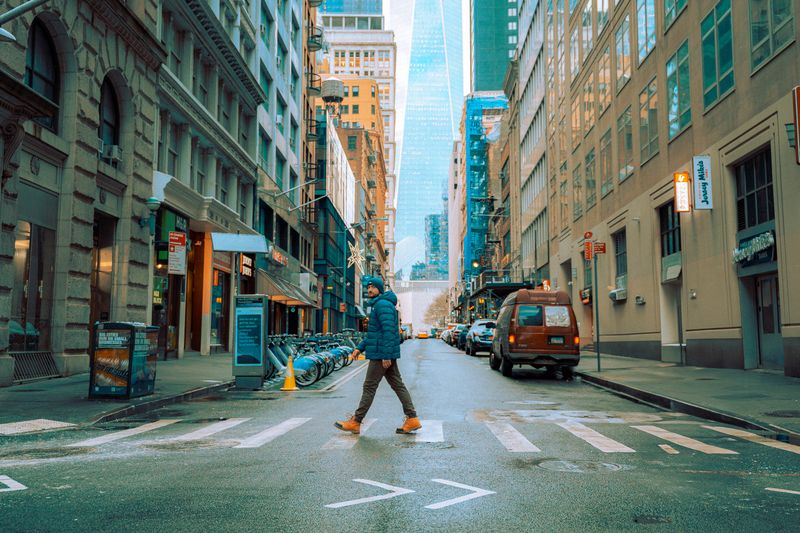
Everything below about pedestrian crossings comes from what actually happens rather than from what is supposed to.
What holds up in practice
- Long waits push people to cross away from the signal.
- Crossing spacing matters as much as crossing quality.
- Assumed walking speeds decide who can finish in one phase.
Waiting is a cost and people price it
A pedestrian standing at a kerb is paying in time for a movement a driver on the same street makes without stopping at all. Once the wait grows past the point where the road looks crossable unaided, a large share of people will step out between vehicles instead. Engineers record this as non-compliance, but it is a rational response to a signal cycle that was optimised for vehicle throughput.
The behaviour is predictable enough that you can stand at a junction and estimate the wait from how many people are crossing against the signal. Shortening the wait usually does more for crossing safety than warning signs or enforcement, because it removes the incentive rather than punishing the response.
Spacing decides whether the crossing is used
A crossing only serves people willing to walk to it, and the detour counts twice, because whatever you walk out you generally walk back. Where formal crossings sit far apart on a busy road, the stretch between them fills with informal crossing that no design has accounted for. Desire lines across a carriageway are visible in worn verges, bent railings and the polished kerb edge where people habitually step down.
Measured properly, putting a crossing where people already cross is cheaper and more effective than trying to redirect them to one that suited the drawing. The counter-argument is that frequent crossings slow motor traffic, which is precisely the trade-off a street with heavy footfall is meant to make.
A stagger moves the wait rather than removing it
A staggered crossing splits the carriageway into two halves with an island between them, so the pedestrian waits twice on a single journey. For traffic engineering that is efficient, because each half of the road can be released independently and green time is easier to allocate.
For a person carrying shopping or pushing a pram it turns one crossing into two, and the total wait often grows rather than shrinks. Staggers are usually offset as well, so walkers must turn towards oncoming traffic, defended as a visibility measure and experienced as a detour. A single-stage crossing is more generous and more expensive in green time, and the choice between the two says what the street is being optimised for.
Assumed walking speed decides who is included
Signal timings are calculated from an assumed walking pace, and that assumption determines what share of the population can cross in one phase. A pace derived from healthy adults leaves older people, small children and anyone using a stick or frame still in the carriageway at the change. Countdown displays help by telling people whether to start crossing, but they do not alter the underlying figure used in the original calculation.
Some cities apply slower default speeds near hospitals, schools and care homes, which is an admission that one number cannot suit every street.
Where a crossing is long, an island a slow walker can genuinely stand on matters more than any adjustment to the timing plan.
Detection decides who has to ask
A push-button crossing requires the pedestrian to request a phase, while vehicle detection grants one automatically the moment a car arrives on the loop. That asymmetry is worth noticing, because the heavier and faster road user is served without asking and the one on foot must make a request.
Buttons that do nothing during peak periods, when the junction runs a fixed plan, quietly teach a whole neighbourhood that the control is decorative. Pedestrian detection can extend a phase while somebody is still in the carriageway, which helps slower walkers without lengthening every cycle of the day. On a street with heavy footfall the honest fix is a walk phase in every cycle, granted whether or not anybody has pressed anything.
Comparisons across cities are difficult because nobody counts the same things.
Reading a crossing before you use it
Stand at a crossing and time the full cycle, because compliance visibly falls away once the wait stretches much beyond a minute. Look at whether the crossing lines up with the pavement on both sides, since one offset from the walking route adds distance nobody planned. Check the dropped kerbs and tactile surfaces at each end, because a crossing that finishes at a full-height kerb is not a crossing for everyone.
Watch what turning vehicles do during the walk phase, as conflicting turns are the commonest reason a perfectly legal crossing still feels dangerous. Ten minutes of this tells you more about a street than collision figures aggregated across a whole city and averaged over several years.
The takeaway
Time the wait. It explains more pedestrian behaviour than anything painted on the road.
The design decision is visible long after the people who made it have gone.
Questions readers ask
Why do people cross against the signal when a crossing is right there?
Usually because the wait is long relative to the gaps in traffic. Behaviour tracks the cost of waiting far more closely than it tracks the rule.
Are staggered crossings safer than single-stage ones?
They simplify vehicle movement and shorten each exposure, but they lengthen the total wait and add a turn. The evidence depends heavily on the street, and neither form is better everywhere.


