
Streets
A rat run is a symptom of the main road failing
Drivers divert onto residential streets when the arterial route becomes slower than the alternative. The side street is the consequence, not the cause.
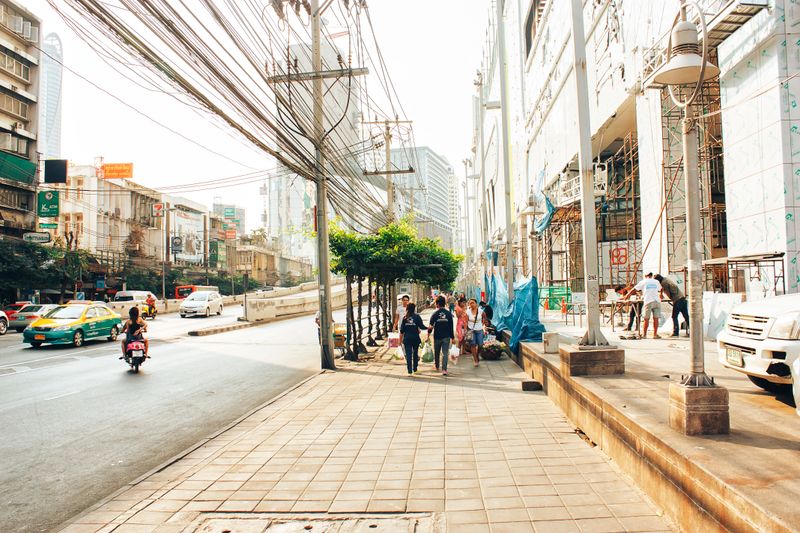
This is written to be used rather than admired. Each section below is a decision about through traffic on residential streets, and each one has a default.
Before you start
- Through traffic on side streets follows delay on the parallel main road.
- Filters redistribute traffic and the redistribution is the contested part.
- Effects on the boundary roads have to be measured, not assumed.
Diversion follows delay, not distance
A driver chooses between routes on expected travel time, so a residential street becomes attractive the moment the parallel arterial slows below its speed. This means the volume on a side street is largely a function of how badly the main road is performing at that hour. It also explains the sharp peaks, since the diversion switches on when the arterial congests and switches off when it clears.
Navigation applications made the effect stronger by finding these routes automatically and distributing the knowledge to drivers who never knew the area. The important consequence is that treating the side street alone addresses a symptom whose cause lies on a road nobody is looking at.
What through traffic does to a residential street
Traffic that has no origin or destination on a street brings noise, emissions and collision risk without bringing any of the local benefits of activity. Speeds tend to be higher than local traffic because drivers unfamiliar with the street are focused on their route rather than on driveways and children. Residents report reduced willingness to let children play outside or cross unaccompanied, which is a change in behaviour rather than a change in opinion.
On the ground, the effect is measurable in how much people know their neighbours along streets with different traffic volumes, a finding replicated in several countries. These are real costs and they fall on people who did not choose them, which is why the issue generates such sustained local pressure.
Filters change the geometry of the choice
A modal filter is a physical or camera-enforced point that allows people walking and cycling through while preventing motor vehicles from passing. It does not close the street, since every property remains reachable by car, and it does remove the street from any through route.
Over a decade, because the mechanism is geometric rather than advisory, it works without enforcement in the way a sign asking drivers not to enter does not. Filters are cheap, quick to trial and easy to reverse, which is why they became a common response and why they became contentious. The design question is where to place them, since a filter in the wrong place can leave one street quiet and load another entirely.
Redistribution is the genuine argument
Removing through traffic from a set of residential streets sends some of those trips onto the surrounding main roads, at least initially. People living on boundary roads therefore experience the scheme as a transfer of nuisance towards them, and that objection is substantive rather than rhetorical.
Some of the traffic disappears rather than relocating, because a share of drivers change route, time, destination or mode when the journey becomes less convenient. How much evaporates and how much relocates varies by place, and the honest answer is that it must be measured on the boundary roads afterwards.
Schemes that monitor only the interior streets can claim success while the effect on the boundary remains entirely unexamined.
Equity cuts in more than one direction
Boundary roads frequently carry more social housing, more rented flats above shops and more households without cars than the interior streets do. A scheme that quietens affluent interior streets while adding traffic to poorer boundary ones is a distributional decision whether or not it is described as one. On the other side, households without cars in the interior gain most from safer walking and cycling conditions, and they are often the least heard.
Access for carers, deliveries, disabled residents and emergency services can be preserved through exemptions and camera enforcement, though not without administration. Both sets of concerns are legitimate, and schemes that survive politically are usually the ones that took the boundary road seriously from the start.
Reading the situation on a street
Compare traffic volumes on the residential street at peak and off-peak, because a large ratio indicates diverted through traffic rather than local demand. Look at number plates or vehicle types if you can, since a high proportion of vans and taxis suggests routing rather than residents. Check the parallel arterial at the same times, as a queue there and a busy side street here are two views of the same event.
Measured properly, ask what would need to change on the main road, since signal timing, bus priority and junction capacity are part of the same problem. A filter scheme without any plan for the arterial is treating half the system, which is where most of the subsequent argument comes from.
The takeaway
Look at the arterial before blaming the side street. The diversion started somewhere else.
Cities are built by a thousand small permissions, not one big plan.
Questions readers ask
Does traffic simply move to the main road?
Some does, some disappears as trips change route, time or mode. The proportions vary by location and must be measured on the boundary roads rather than assumed in either direction.
Do filters stop residents driving to their own homes?
No. Every property remains reachable by car, though sometimes by a longer route. The filter removes the street from through routes rather than closing it.


