
Streets
Guardrail was installed to protect pedestrians and now herds them
Metal railing along a kerb was a safety measure with a clear rationale. Cities have spent years discovering what else it does.
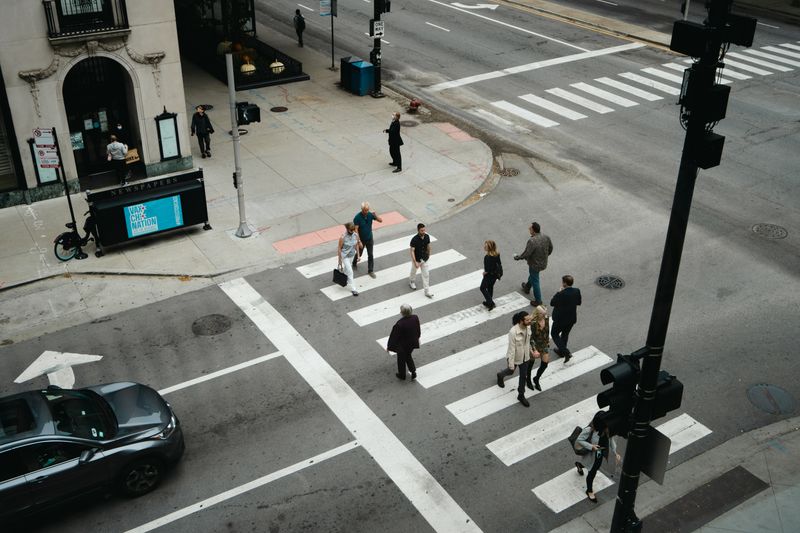
The points below about pedestrian guardrail are ordered by how much difference they make, not by how often they get repeated.
What matters most
- Guardrail was introduced to keep people away from moving traffic at junctions.
- It lengthens walking routes and pushes crossing to places without visibility.
- Removal programmes have generally not produced the harm predicted.
The original logic was containment
Guardrail appeared as a response to pedestrian casualties at junctions, on the reasoning that physically separating people from vehicles must reduce conflict. It was installed most heavily where traffic volumes were highest, which is also where pedestrian numbers were highest, so it shaped busy places disproportionately. The measure treats the pedestrian as the hazard to be managed, which reflects the road safety thinking of the period in which it spread.
It also has a genuine engineering function in specific locations, such as at the top of a steep bank or beside a fast slip road. The problem is not that the rationale was absurd but that it was applied uniformly to situations where the calculus is entirely different.
It lengthens journeys and moves the risk
A pedestrian facing railing cannot cross where they are standing, so they walk to a gap, and the walk is added at both ends of the trip. If the gap is far enough away, a proportion of people climb over or walk in the carriageway alongside the railing to reach the gap. Crossing beside a railing is more dangerous than crossing at the same point without one, because there is no escape route back to the footway.
Railing also narrows the effective footway, since people avoid walking directly against it, which matters most at exactly the crowded junctions where it appears. So a measure intended to separate people from traffic can produce crossings in worse positions and less room to wait.
Visibility works in both directions
Guardrail obscures children and wheelchair users from drivers approaching a junction, especially where it is solid or carries advertising panels. It also obscures the driver from the pedestrian, which removes the mutual awareness that lets both parties adjust before a conflict develops. For cyclists, railing at a junction creates a trap where a turning lorry can leave no room to move sideways.
In practice, that specific hazard has driven removal in a number of cities independently of any wider argument about pedestrian movement. Where railing is retained for a good reason, an open design with a high visibility gap addresses part of the problem at modest cost.
Removal programmes and what they found
Several cities have removed guardrail systematically and monitored casualty rates at the treated junctions afterwards. The general finding has been that removal did not produce the increase in pedestrian casualties that opponents expected, and in places conditions improved. One likely explanation is that drivers approach a junction with visible pedestrians more cautiously than one where people appear to be contained.
At street level, the evidence is not uniform, sites differ, and the responsible conclusion is that blanket installation and blanket removal are both crude. What the studies do support is that guardrail should be justified at each location rather than applied as a default treatment.
What replaces it
Where the underlying problem is vehicle speed, geometry changes such as tighter corner treatment and raised crossings address the cause instead. Where the problem is crossing demand, adding a formal crossing at the desire line removes the reason for the railing altogether. Where a genuine hazard exists, bollards or planting can provide separation without creating a continuous barrier along the kerb.
In practice, removing railing also frees footway width, which at a busy junction can be worth more than any other intervention available. The maintenance saving is not trivial either, since damaged railing must be repaired repeatedly at locations where vehicles strike it.
Judging a length of railing
Ask what would happen if it were absent, because if the answer is that people would cross safely then it is serving no protective purpose. Measure the detour to the nearest gap, since anything beyond a short walk will be defeated by a share of pedestrians. Look for wear marks, worn grass or scuffs on the rail itself, as these show where people are climbing over rather than walking round.
Over a decade, check whether it sits between a bus stop and a crossing, which is a common and particularly counterproductive arrangement. Note whether it carries advertising, because a solid panel converts a visibility problem into a much larger one.
Everything above, in order of what to do first
- The original logic was containment. Guardrail appeared as a response to pedestrian casualties at junctions, on the reasoning that physically separating people from vehicles must reduce conflict.
- It lengthens journeys and moves the risk. A pedestrian facing railing cannot cross where they are standing, so they walk to a gap, and the walk is added at both ends of the trip.
- Visibility works in both directions. Guardrail obscures children and wheelchair users from drivers approaching a junction, especially where it is solid or carries advertising panels.
- Removal programmes and what they found. Several cities have removed guardrail systematically and monitored casualty rates at the treated junctions afterwards.
- What replaces it. Where the underlying problem is vehicle speed, geometry changes such as tighter corner treatment and raised crossings address the cause instead.
- Judging a length of railing. Ask what would happen if it were absent, because if the answer is that people would cross safely then it is serving no protective purpose.
The takeaway
Ask what a railing is stopping. If the answer is a crossing people need, it is causing the problem.
The design decision is visible long after the people who made it have gone.
Questions readers ask
Is removing guardrail dangerous?
Monitoring in cities that removed it systematically has generally not shown the predicted rise in casualties. Results vary by site, which is an argument for assessing each location rather than applying a default.
Why is guardrail still installed at all?
Because it has legitimate uses at specific hazards, and because it is a cheap, visible response after an incident. The second reason accounts for much of the length now in place.


