Buildings
Service charges are a design outcome nobody prices at the start
The lifts, plant, landscaping and cladding access chosen in year one become a bill residents pay every year afterwards.

What follows is the working version of building running costs: the decisions in the order you actually meet them, with the reasoning attached.
Before you start
- Shared plant, lifts and landscaping generate recurring costs proportional to what was specified.
- Facade access strategy determines maintenance cost for the life of the building.
- Buyers see the purchase price and rarely see the long-run charge.
Every shared component is a recurring bill
Lifts require servicing contracts and periodic replacement; pumps, ventilation plant and communal heating systems require the same. Landscaped communal areas require grounds maintenance; concierge desks require staff; car parks require lighting, cleaning and enforcement.
None of these costs appear in the sale price, and all of them appear in the annual charge. A design that maximises shared amenity is also a design that maximises the recurring cost of living there.
Facade access is the largest hidden item
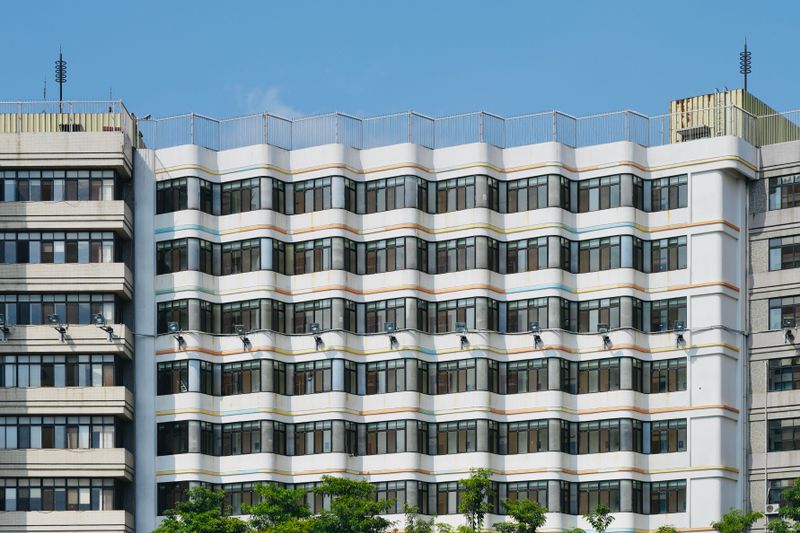
Cleaning and maintaining a tall facade requires either a building maintenance unit on the roof, permanent anchor points, or repeated hire of access equipment. A roof-mounted unit is expensive to install, expensive to maintain and expensive to replace, and it is decided in the design stage. Complex facades with many reveals, projections and inaccessible surfaces multiply the labour required for every cycle.
In practice, a simple facade with straightforward access can cost a fraction of an elaborate one to keep clean over decades.
Communal heating concentrates the risk
District or communal heat systems can be efficient, and they also make every resident dependent on the same plant, pipework and billing arrangement. Heat losses from communal distribution pipework in buildings have been found in several studies to be substantially higher than designed. Where standing charges are high and consumption is low, residents in small flats can pay disproportionately.
Over a decade, metering, billing and governance arrangements differ widely and are frequently the source of dispute rather than the technology itself.
Sinking funds separate the responsible from the rest
Major components — lifts, roofs, boilers, cladding — have finite lives and predictable replacement costs. A reserve or sinking fund spreads that cost across the years, and buildings without one hit residents with sudden large demands. Whether such a fund is required, permitted or taxed differs by jurisdiction and by tenure structure.
The absence of one is a strong signal about how a building will be managed in twenty years.
Governance decides whether costs stay reasonable
Who appoints the managing agent, who can challenge the charges, and how disputes are resolved differ enormously between ownership systems. Commonhold, condominium, strata and leasehold arrangements distribute control very differently, and residents rarely understand theirs before buying. Where the freeholder appoints the agent and residents cannot easily change it, the incentive to control costs is weak.
Reform of these arrangements has been an active political issue in several countries for exactly this reason.
Local statute governs most of this, and it varies street by street.
The design lesson is restraint
Fewer lifts serving well-planned cores, simple robust landscaping and accessible facades reduce charges permanently without reducing quality. Amenities that are used constantly justify their cost; amenities included to sell the scheme frequently do not. Whole-life costing exists as a discipline and is rarely applied to residential development because the developer does not pay the running costs.
Asking what the building costs to run is the single most useful question a buyer can put to a sales office.
The takeaway
Ask what the building costs to run before you ask what it costs to buy.
Cities are built by a thousand small permissions, not one big plan.
Questions readers ask
Why are service charges higher in new buildings?
Newer buildings typically have more shared plant, lifts, communal areas and amenity space than older ones, and each of those has a maintenance contract behind it.
Can service charges be challenged?
The mechanisms depend entirely on your jurisdiction and tenure. Most systems provide some route to challenge unreasonable charges, and the practical difficulty of using it varies enormously.