
Transit
Bike parking is the cheapest capacity a station can add
A secure rack extends a station catchment from a ten-minute walk to a fifteen-minute ride, for the cost of a few metres of pavement.
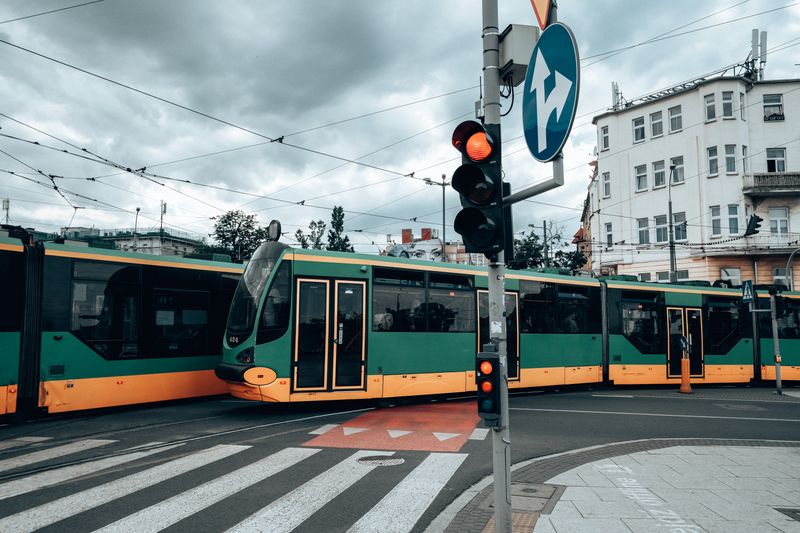
This looks at cycle parking at stations from the practical end — what holds up once conditions stop being ideal.
What holds up in practice
- Cycling multiplies the area within a given travel time to a station several times over.
- Theft risk suppresses cycling to stations more than distance does.
- Cycle parking costs a fraction of car parking per user served.
Catchment grows with the square of speed
A station catchment is roughly the area reachable within an acceptable access time, and area grows with the square of the distance covered. Cycling covers three to four times the distance of walking in the same time, which expands the catchment area by roughly an order of magnitude.
That is a very large increase in the population served, obtained without moving the station or changing the service. This is why cycle access is treated as core network infrastructure in countries with high cycling rates rather than as an amenity.
Theft is the binding constraint
Surveys of would-be station cyclists consistently identify theft risk as the main deterrent, ahead of route quality or weather. A bike left at a station is unattended for a predictable period in a predictable place, which is close to ideal conditions for a thief.
In practice, secure enclosed parking with access control changes the calculation entirely and is far more expensive per space than open racks. A tiered offer — open racks for short stays, secure enclosures for commuters — matches the cost to the risk.
Space efficiency is the argument that wins
Roughly ten bicycles fit in the space one car occupies, and the construction cost per space is a small fraction. Converting a handful of station car parking spaces to cycle parking usually serves more passengers, not fewer. That conversion is politically difficult because the car spaces are visibly used and the cycle demand is latent.
Across a network, cities that built substantial secure capacity have generally found it fills, which is the standard pattern for suppressed demand.
Design details decide usage
Two-tier racks double capacity per square metre and are difficult for some users, particularly with heavier bikes. Wheel-bending racks that support only the front wheel are widely disliked and provide poor security against frame theft. Stands allowing the frame to be locked at two points are the standard recommendation in most design guidance.
Cargo bikes, adapted cycles and trailers need larger bays, and their omission quietly excludes families and disabled cyclists.
The alternative solutions have limits
Carrying bicycles on trains works at low volumes and consumes space that is scarce at peak times. Folding bicycles resolve this for the people willing to use them and are a partial answer at best.
In practice, bike share at both ends removes the ownership problem and depends on redistribution and on stations having docks free. None of these scale as cheaply as letting people leave their own bike securely at the station.
Comparisons across cities are difficult because nobody counts the same things.
It should be planned as network capacity
A station short of platform or vehicle capacity can sometimes absorb growth by shifting access mode rather than by adding trains. Passengers arriving by bike also reduce demand for feeder bus services and station car parking simultaneously. Where cycle parking is provided by the station operator and cycle routes by the highway authority, neither has an incentive to plan the whole journey.
The countries that do this well have generally resolved that institutional split rather than found a better rack.
The takeaway
Widen the catchment before you widen the platform. It is a hundred times cheaper.
The design decision is visible long after the people who made it have gone.
Questions readers ask
How much cycle parking does a station need?
Enough that it is never full, because full racks turn people away permanently. Demand has generally exceeded projections wherever secure capacity was provided, so planning to current usage understates it.
Is it better to carry a bike on the train?
For occasional trips, yes. For daily commuting at peak times it consumes scarce vehicle space, which is why most networks restrict it and invest in parking at both ends instead.


